
The Ultimate Guide to LED Screens: Pixel Pitch, Cabinets, Viewing Distance & Applications
LED screens have transformed how businesses communicate, advertise, and entertain. From towering outdoor billboards to stunning transparent displays in shopping mall windows, the applications are nearly endless.
But if you’re new to LED technology, the terminology can be overwhelming. What exactly is pixel pitch? Why do cabinets matter? And how do you know which screen is right for your project?
This guide answers all those questions and more.
Part 1: What Is Pixel Pitch? (And Why It Matters)
Pixel pitch is the most important specification of any LED display. It refers to the distance, in millimeters, between the center of one LED cluster (pixel) and the center of the next cluster alongside, below, or above it .
Think of it this way: a smaller pixel pitch means the LEDs are packed more tightly together. A larger pixel pitch means there is more space between each LED.
Common pixel pitch examples:
- P1.2, P1.5, P1.9: Ultra-fine pitch (high density)
- P2.5, P2.6, P2.9: Fine to medium pitch
- P3.9, P4, P4.8: Standard pitch
- P5, P6, P8, P10: Large pitch (lower density)
Significant cost is determined by pixel pitch because a display with a 1.5mm pixel pitch requires many more LED clusters per square meter than a display with a 4mm pixel pitch . The robotic manufacturing process to place millions of tiny LEDs takes time, and that cost is reflected in the final product.
The Key Trade-Off: Clarity vs. Cost
| Lower Pixel Pitch (P1.2 – P2.5) | Higher Pixel Pitch (P4 – P10) |
|---|---|
| High resolution, crisp image quality | Lower resolution, visible pixels up close |
| Higher cost per square meter | Lower cost per square meter |
| Best for close viewing distances (2-10m) | Best for long viewing distances (10-50m+) |
| Indoor applications | Outdoor/large venue applications |
Part 2: The Building Blocks – Modules, Cabinets, and Walls
Understanding how LED screens are constructed will help you make better purchasing decisions.
LED Module
The smallest replaceable unit. A module contains the LED clusters, driver ICs, and a small PCB. Common module sizes include 160×160mm, 320×160mm, and 250×250mm .
LED Cabinet (or Panel)
A cabinet is the mechanical frame that holds one or more modules . This is what you physically mount and connect together. Cabinets typically come in standard sizes like 500×500mm, 500×1000mm, 300×525mm, or 1000×500mm .
Why cabinets matter:
- Structural integrity: Cabinets provide the rigid frame that keeps everything flat and aligned.
- Seamless tiling: Precision manufacturing ensures gaps between cabinets are invisible (usually ≤0.2mm tolerance) .
- Ease of installation: Cabinets are designed to lock together quickly with levers or latches.
- Maintenance: Many cabinets allow front-service access, meaning you can replace a faulty module without removing the entire cabinet from the wall .
The Complete Video Wall
Multiple cabinets tile together to form the final display. A 4K resolution video wall (3840×2160 pixels) requires a specific number of cabinets. For example, with a P2.5 cabinet that has 200×200 pixels per 500×500mm cabinet, you would need 20 cabinets wide and 11 cabinets tall to achieve 4K resolution . That’s a wall roughly 10 meters wide by 5.5 meters tall.
Part 3: Pixel Pitch & Viewing Distance – The Golden Rule
Selecting the wrong pixel pitch for your viewing distance is the most common mistake in LED screen buying.
| If pixel pitch is too large for the viewing distance, the image will appear pixelated and broken up. |
If you choose a pitch that is too small, you are paying for resolution that the human eye cannot perceive at that distance.
The Industry Standard Formula
A simple rule of thumb is: 1mm of pixel pitch ≈ 1 meter (3.3 feet) of minimum viewing distance
This means:
- P2.5 screen: Minimum viewing distance of approximately 2.5 meters (8 feet)
- P3.9 screen: Minimum viewing distance of approximately 3.9 meters (13 feet)
- P6.6 screen: Minimum viewing distance of approximately 6.6 meters (22 feet)
- P10 screen: Minimum viewing distance of approximately 10 meters (33 feet)
For a more precise formula used by professionals: Viewing distance (m) = Pixel Pitch (mm) × 1000 . A P2.6 panel should be viewed from at least 2.6 meters away.
Recommended Pixel Pitch by Application
| Application | Typical Viewing Distance | Recommended Pixel Pitch |
|---|---|---|
| Control rooms, broadcast studios | 1-2 meters | P0.9 – P1.5 |
| Corporate boardrooms, retail displays | 2-5 meters | P1.5 – P2.5 |
| Shopping mall atriums, indoor signage | 3-8 meters | P2.5 – P3.9 |
| Indoor events, conference stages | 5-15 meters | P2.6 – P3.9 |
| Outdoor digital billboards (street level) | 8-20 meters | P4 – P6 |
| Outdoor advertising (highway/distant) | 20-50+ meters | P6 – P10+ |
Pro Tip: Always spec your pixel pitch based on the closest audience member, not the average viewing distance. One person in the front row seeing individual pixels is one complaint too many .
Part 4: Types of LED Screens and Their Applications
Different applications require different types of LED technology.
1. Indoor Fixed Installation LED Screens
These are the most common type of LED displays for permanent indoor use. They are designed for high resolution and excellent color accuracy.
Applications:
- Retail stores and shopping malls: Catch customer attention with dynamic product promotions. Digital signage has been shown to increase purchase intent by an average of 31% compared to static signage .
- Clothing and apparel shops: Display your latest collection in motion. Show models wearing outfits, video testimonials, and runway footage .
- Corporate lobbies and boardrooms: Make a strong first impression with a stunning video wall that displays your brand, welcome messages, or real-time data.
- Restaurants and fast-food chains: Use digital menu boards that can be updated instantly to promote daily specials and high-margin items .
- Transportation hubs (airports, train stations): Provide dynamic, up-to-the-minute passenger information with real-time updates .
2. Outdoor LED Displays
Outdoor screens must contend with direct sunlight, rain, dust, and temperature extremes. They require much higher brightness levels (typically 5,000-8,000 nits) and robust weatherproofing (IP65 rating minimum).
Applications:
- Digital billboards: The classic application. High-resolution LED billboards generate 4 times the brand awareness compared to traditional static billboards .
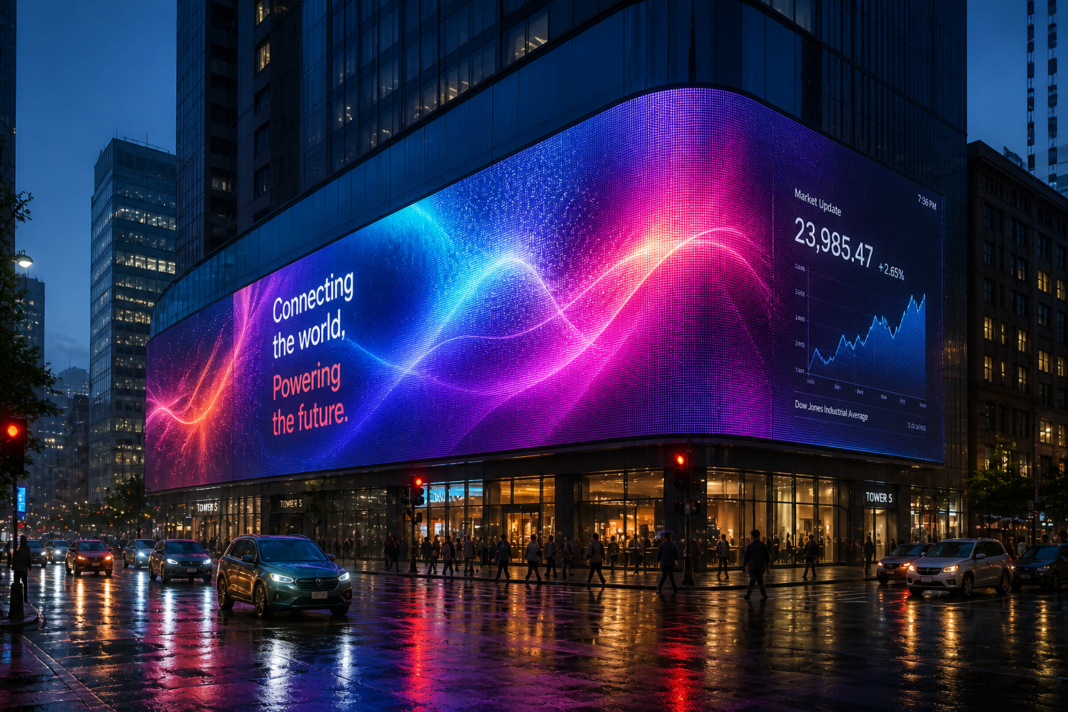
- Building facades: Transform an entire building into a media canvas.
- Stadium and arena displays: Scoreboards, replay screens, and perimeter advertising.
- Drive-thru menu boards: Bright, clear displays that are readable even in direct sunlight.
3. Transparent LED Screens
This is one of the most exciting innovations in LED technology. Transparent LED screens have a see-through design with a transparency rate of 60-90% .
How it works: The LEDs are mounted on a transparent substrate or within a mesh-like structure. When the screen is off (or playing dark content), you can see right through it to the products or architecture behind. When it’s playing vibrant video, the content appears to float in mid-air.
Why this is revolutionary for retail: A transparent LED screen in a shop window allows you to play dynamic video advertisements while still allowing passersby to see inside the store . You don’t have to choose between a beautiful window display and a digital screen – you get both.
Applications for transparent LED:
- Retail shop windows (clothing, jewelry, electronics): Showcase products with video while maintaining visual access to the store interior .
- Shopping mall atriums and glass facades: Turn entire glass walls into media displays without blocking natural light .
- Car dealership showrooms: Display promotional videos on the glass while customers can still see the cars inside.
- Museums and exhibition spaces: Create immersive displays that don’t obstruct the view of artifacts.
- Bars, nightclubs, and stage scenery: Add a futuristic visual element without creating a solid wall .
- Elevator glass (sightseeing elevators): Transform a simple elevator ride into a media experience .
Key specifications of transparent screens:
- Pitch options: P3.9-7.8mm, P10.4, P15.6, and custom
- Transparency: 60% – 90% depending on pitch
- Brightness: Up to 5,500 nits (readable in direct sunlight)
- Refresh rate: 3840Hz minimum (broadcast-ready, flicker-free)
- Cabinet size: Typically 1000×500mm
4. Rental and Staging LED Screens
These screens are designed for temporary events. They prioritize speed of assembly, durability for transport, and lightweight construction.
Key features of rental screens:
- Fast locking systems: Cabinets can be joined together in seconds without tools .
- Lightweight design: Professional rental cabinets range from 5.5 kg to 10 kg per cabinet. The difference matters – a 6m × 4m screen requires 96 cabinets, so the difference between 6 kg and 8 kg cabinets is 192 kg of truss load .
- Protective edges: Corner protection to survive life on the road.
- Flight cases: Optional hard cases for safe transport .
Applications:
- Concerts and music festivals: Main stage screens, side screens, and IMAG (Image Magnification) displays .
- Corporate events and trade shows: Stage backdrops, booth displays, and keynote presentations .
- Political rallies and award shows: Large-scale public events .
- Outdoor festivals: Shows that set up and tear down quickly.
5. Creative and Curved LED Screens
For truly unique installations, flexible or curved LED panels allow for concave, convex, and even full 360-degree cylindrical displays.
Applications:
- Architectural features: Wrapping around columns or creating wave-shaped walls.
- Immersive experiences: 360-degree LED rooms.
- Stage design: Curved backdrops that wrap around performers.
Part 5: Key Technical Specifications Beyond Pixel Pitch
When evaluating LED screens, pay attention to these additional specifications.
Brightness (Nits / Candela per square meter)
- Indoor screens: 800 – 1,500 nits (too bright can cause eye strain in dark rooms)
- Outdoor screens (direct sunlight): 5,000 – 8,000+ nits
Refresh Rate (Hz)
The refresh rate determines how often the image is updated per second. For broadcast and video applications, a minimum of 3,840 Hz is recommended to prevent flickering on camera .
Gray Scale (Bits)
This affects how smooth color gradients appear and how well the screen reproduces subtle color variations. Professional screens offer 14-16 bit gray scale .
IP Rating (Ingress Protection)
This indicates resistance to dust and water.
| IP Rating | Protection Level | Application |
|---|---|---|
| IP30 – IP31 | Dust-resistant, no water protection | Indoor only |
| IP40 | Some dust protection | Indoor with dust concerns |
| IP54 – IP65 | Water-resistant to waterproof | Outdoor or damp environments |
| IP65+ (IP67, IP68) | Fully waterproof, dust-tight | Permanent outdoor, harsh conditions |
Viewing Angle
This indicates how far off-center you can view the screen before image quality degrades. Professional screens offer 140° horizontal and 120-140° vertical viewing angles .
Weight
For permanent installations, weight determines structural requirements for the wall or building. For rental screens, weight affects transport costs and crew fatigue .
Part 6: Choosing the Right Solution for Your Business
For Retail and Shopping Centers
Challenge: How do you stand out when consumers are exposed to 4,000 to 10,000 advertising messages every day?
Solution: High-resolution LED screens combined with transparent displays for window applications.
Recommended approach:
- Window displays: Transparent LED (P3.9, P10.4) – visibility from both sides
- In-store signage: Fine pitch indoor LED (P1.9 – P2.5) for high-impact promotions
- Mall atriums: Large format indoor screens (P2.5 – P3.9) for advertising and wayfinding
For Events and Staging Companies
Challenge: Fast setup, easy transport, reliable performance, and broadcast-quality visuals.
Solution: Rental-grade cabinets designed for quick assembly.
Recommended approach:
- Concerts (large venues): P3.9 – P4.8, lightweight cabinets (6.5-9 kg per cabinet), IP65 for outdoor
- Corporate events (intimate): P2.6 – P2.9, higher resolution for closer viewing
- LED floors: Special reinforced cabinets (P1.5 – P2.6) with matte finish for slip resistance and compression resistance
For Corporate and Commercial Spaces
Challenge: Professional appearance, reliable performance, and appropriate resolution for meeting rooms and lobbies.
Solution: Fine pitch indoor LED screens with high CRI (Color Rendering Index) for accurate skin tones and brand colors.
Recommended approach:
- Boardrooms: P1.2 – P1.5 for exceptional clarity up close
- Lobbies and reception areas: P1.5 – P2.5 for impressive first impressions
- Control rooms: P1.2 – P1.5, high refresh rate for real-time data monitoring
For Outdoor Advertising
Challenge: Visibility in direct sunlight, weather resistance, and cost-effectiveness for large areas.
Solution: High brightness outdoor screens (5,000+ nits) with IP65+ ratings and wider pixel pitches.
Recommended approach:
- Street-level billboards: P4 – P6 (viewed from 10-20 meters)
- Highway billboards: P8 – P10+ (viewed from 30-50+ meters)
- Building facades: P6 – P10 with high transparency options if mounted on windows
Part 7: Common Installation Methods
Part 8: Total Cost Considerations
The pixel pitch is usually why LED cabinets of the same brand and dimensions can vary significantly in price . But the cabinet itself is only part of the total system cost.
What’s included in a complete system:
- LED cabinets with modules (the display itself)
- Power supplies (often integrated into cabinets)
- Receiving cards (one per cabinet)
- Sending card (main controller for the entire wall)
- Cabling (power and data distribution)
- Mounting structure (steel frame, wall mounts, or rigging)
- Installation labor
- Content management software (often included)
- Flight cases (for rental screens)
Hidden costs to budget for:
- Shipping (large, heavy items)
- Import duties and taxes (for international purchases)
- Spare modules and power supplies (recommended 5-10% of total)
- Extended warranty or service contracts
- Professional commissioning (calibration and setup)
Conclusion
LED screens are powerful tools for communication, advertising, and entertainment. By understanding the relationship between pixel pitch and viewing distance, the modular nature of cabinets, and the different types of LED screens available (indoor, outdoor, transparent, rental), you can make an informed decision that delivers the right balance of image quality and budget for your specific application.
The key takeaways:
- Calculate your viewing distance – Let this guide your pixel pitch selection
- Match the technology to the application – Transparent for windows, high-brightness for outdoor, lightweight for rental
- Budget for the complete system – Not just the cabinets, but also mounting, control, and installation
- Don’t over-spec or under-spec – A P1.5 screen viewed from 20 meters is wasted money. A P6 screen viewed from 3 meters will look pixelated and unprofessional
Have Questions About Your Specific Project?
Choosing the right LED screen can be complex. Whether you need a transparent display for your shop window, a high-resolution video wall for your corporate lobby, or a rental-grade screen for your next event, we’re here to help.
Contact us to discuss your project requirements, and we’ll recommend the perfect solution for your space, viewing distance, and budget.
contact@seventhangle.com